How to trade memecoins with a small portfolio and keep fees from eating the account
You can order the same kind of articles for your own video to boost it on YouTube and Google. Just message the Telegram bot @sat_sit_bot. It writes articles around your video, embeds the video and publishes them on popular niche websites (no ads). Try it free: 50 articles on us.
· based on the channel gravy
Memecoin trading with a small portfolio is possible if you keep each buy under 0.05 SOL, pick coins with a live narrative rather than a chart pattern, and accept that fees and slippage are a fixed tax you must clear before any profit counts. The experiment behind this guide — five trades on a roughly $10 bankroll, routed through Axiom — shows the mechanics are open to anyone, but the edge comes from narrative timing, not from the size of the deposit.
What a $10 memecoin portfolio actually buys on Solana
A ten-dollar bankroll on Solana is not a handicap in itself; the constraint is that every trade must be large enough to matter and small enough that fees do not dominate. With SOL trading in the low hundreds of dollars, 0.05 SOL is about $10, so a single position can consume the whole account unless you split it. The practical structure is four to five entries of 0.02–0.05 SOL each, which leaves room to be wrong several times in a row.
Costs stack in three places:
- Swap fees on the aggregator or router, which referral programs advertise as discounted — Axiom markets 2x cashback and 15% lower fees on its referral tier.
- Priority fees and network fees on Solana, small per transaction but meaningful as a percentage when the transaction is $5.
- Slippage and price impact, which on thin pump.fun-style liquidity can exceed every other cost combined.
Run the math before the trade: if round-trip costs plus expected slippage are 5–8% of a $5 position, the coin must move roughly 10% just to break even after a partial exit. That is the real reason small portfolios fail — not the deposit size, but trading too often on positions too small to clear the cost floor.
The five trades and what each one was really testing
The experiment covered five positions, each bought for a specific narrative reason rather than a technical setup, and each sold for a stated reason. That discipline — writing down why you bought before you buy — is what separates a trade from a gamble.
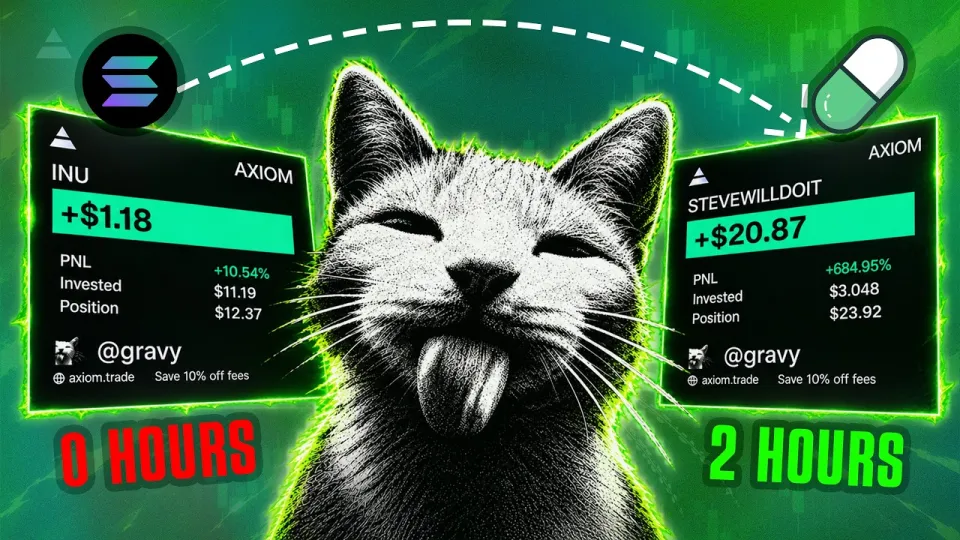
- STEVEWILLDOIT — a character-driven meme with a recognizable name, the kind of coin that spreads through short-form video and reply threads. Entry logic: attention is already moving, so the question is only whether liquidity is deep enough to exit.
- NPC — the "NPC" archetype, a meme with built-in irony and endless remix potential. These coins live or die on how quickly the joke gets reused by accounts with reach.
- MET (Meteora) — a token tied to a recognizable Solana protocol brand rather than a pure joke, which changes the holder base and usually the volatility profile.
- PUMPY the Trader — a trader-culture meme, aimed at the same audience that is already watching memecoin content.
- UNTXD — the trade that was fumbled badly, and therefore the most instructive of the five.
The X Money coin meta that ran alongside these is a useful case study: it moved on an e/acc and Cream narrative, meaning traders were pricing a story about who was building and who was aligned, not a product. Memecoin narratives in 2026 behave the same way — the coin is a bet on a story spreading, and the story has a shelf life measured in hours or days.
How to size positions when the whole account is $10
Position sizing is the single decision that determines whether a small memecoin account survives long enough to learn anything. A workable rule set for a bankroll this size:
- Cap each buy at 0.05 SOL. That is the ceiling from the experiment, and it keeps any single loss from ending the session.
- Split into at least four entries. Four shots at 0.02–0.025 SOL gives you room for three failures and one winner, which is the realistic hit rate.
- Never add to a loser. Averaging down on a memecoin with no bid support converts a small loss into a total one.
- Take partial profit on the first strong impulse. Selling half on a 40–60% move locks in enough to fund the next two trades.
- Stop trading when the bankroll halves. A $10 account that becomes $5 needs a reset, not revenge trades.
The uncomfortable truth is that fees are a larger share of a $5 trade than of a $500 trade, so a small portfolio must trade less frequently, not more. Fewer, better-narrated positions beat volume every time at this size.
Reading narratives instead of chasing charts
The most common complaint from traders attempting this is that finding coins with good narratives feels overwhelming — too many tweets, too many influencers to track, and by the time a dip looks buyable, everyone else is selling. The fix is to narrow the funnel rather than widen it.
Build a short, fixed watchlist of accounts whose calls you have actually verified, and check them on a schedule instead of continuously. When a narrative appears, ask three questions before buying: who is repeating it, how long has it been running, and what does the liquidity look like on the pair you would exit into. A narrative in its first hours behaves very differently from the same narrative on day three, when the early buyers are the ones selling to you.
The second failure mode is exit discipline. Selling a 20–40% loss and then watching the coin run higher is not bad luck — it usually means the position was sized too large for the account, so the drawdown felt unbearable. Smaller positions make holding through normal volatility possible, which is how you avoid becoming the liquidity for someone else's exit.
Common questions from traders starting with a tiny balance
Traders attempting this usually hit the same three walls: whether the math can work at all, how to find narratives without drowning in social feeds, and what to do after a loss. On the math, the answer is yes, but only with a strict cost ceiling and fewer trades. On narratives, the answer is a short verified list plus scheduled checks, not constant scrolling. On losses, the answer is a hard stop on the session once the bankroll halves.
A related question is whether to trade from a public, doxxed wallet. Doing so removes the temptation to hide bad trades and forces the same discipline a public track record demands — which is exactly the accountability a small account needs to improve.
Useful links
- Axiom trading terminal with referral terms (2x cashback, 15% lower fees): https://axiom.trade/@gravy
- The Trenches Discord: https://discord.gg/W7TqkExcSd
- Discord with free Axiom imports and trade signals (not financial advice): https://discord.gg/9W5j3XUgYB
- Author's X account: https://x.com/gravyski
- Leverage trading with a 20% futures fee reduction: https://www.bitbase.com/landing-page/trading-earning-Gra?ref=8CYOGY
Bottom line
Trading memecoins with a small portfolio is a discipline problem disguised as a capital problem: five buys under 0.05 SOL each can work, but only if position sizing, narrative timing and exit rules are decided before the trade. The five-trade experiment shows the mechanics are accessible to anyone with a Solana wallet and a few dollars, and that the losses come from process errors — oversized positions, late entries, panicked exits — rather than from the account being small. The most valuable output of the run is the trade that was fumbled, because it shows exactly where discipline breaks. The breakdown comes from the gravy channel, which documents each entry and exit rather than only the winners. If you want to test the same setup, start with a small balance on Axiom and treat the first ten trades as tuition rather than income.
Key takeaways
- Five real trades on Solana, each buy under 0.05 SOL — roughly $10 total at SOL prices near $200.
- Coins traded: STEVEWILLDOIT, NPC, MET (Meteora), PUMPY the Trader and UNTXD.
- Trades were routed through Axiom, which advertises 2x cashback and 15% lower fees via referral.
- The X Money coin meta ran on an e/acc and Cream narrative rather than on product fundamentals.
- One trade was fumbled badly — the recurring failure mode is selling a 20–40% loss right before the coin runs.
Source: I Tried Trading Memecoins with Just $10 · Markdown version
Questions & answers
Can you really trade memecoins with only $10?
Yes, mechanically — on Solana a $10 bankroll is roughly 0.05 SOL, enough for four or five small entries. The constraint is cost: swap fees, priority fees and slippage take a larger percentage of a $5 position than a $500 one, so you must trade less often and target bigger moves to clear the cost floor.
How do you find memecoins with good narratives without living on social media?
Narrow the funnel instead of widening it: keep a short list of accounts whose calls you have verified, check them on a schedule, and ask who is repeating the narrative, how long it has been running, and how deep the exit liquidity is. A narrative in its first hours is a different trade from the same narrative on day three.
Why do small-portfolio traders keep selling at a 20–40% loss right before the coin runs?
Usually because the position was too large relative to the account, so normal volatility felt unbearable. Sizing each buy at 0.02–0.05 SOL and taking partial profit on the first strong impulse makes it possible to sit through drawdowns instead of becoming exit liquidity for earlier buyers.
What is the biggest mistake in a five-trade experiment like this?
The fumbled trade matters more than the winners, because it exposes the process error — a late entry, an oversized position or a panicked exit. Writing down the reason for each buy before executing turns those mistakes into a repeatable checklist rather than a story about bad luck.